
Select your language
Damp on walls: when is it normal and when should you be concerned?
Novidades
Hits: 15
- Author Image:

How to identify different types of damp in your home and solve the problem properly
With autumn comes the first heavy rain, and with it, familiar problems begin to appear.
A new damp stain that was not there before the summer holidays. A slightly unusual smell in a storage room. A wall beginning to crumble or deteriorate near the skirting board. A wooden floor that suddenly looks darker.
And the first question is always the same: Is this serious, or is it normal? The honest answer is: it depends on the type of damp.
This is where many people — buyers, sellers and even some professionals — make the same mistake: treating all damp problems as if they were the same. They are not.
There are three main types of damp in a property, each with different causes, different solutions and, most importantly, very different levels of severity.
Why does damp appear more often in autumn?
It is not a coincidence that damp stains often become more visible between September and November. During the summer, higher temperatures and drier conditions can dry out building materials and temporarily conceal problems that were already present. When the first consistent rainfall arrives and temperatures begin to fall, water can once again find its way through walls, ceilings and floors.
As a result, problems that were hidden during the summer can suddenly become visible.
This means that a property may appear completely dry during a viewing in July, while still having significant moisture problems that only become apparent several months later.
The three types of damp — and why the difference matters
1. Condensation damp: Condensation is the most common type of damp and, in general, the least serious. It occurs when warm, humid indoor air comes into contact with a cold surface.It commonly appears in:
- Poorly ventilated corners
- External walls with insufficient insulation
- Bathrooms without adequate ventilation or extraction
- Around windows
- Behind furniture placed against external walls
Condensation is often identified by dark, rounded damp patches, frequently accompanied by mould. The affected areas are usually concentrated in specific locations, such as ceiling corners, behind wardrobes or cupboards against external walls, and around windows. In most cases, condensation is primarily related to ventilation, indoor humidity and insulation, rather than a structural defect. However, that does not mean it should be ignored. Long-term exposure to mould can affect indoor air quality and may have an impact on the respiratory health of people living in the property.
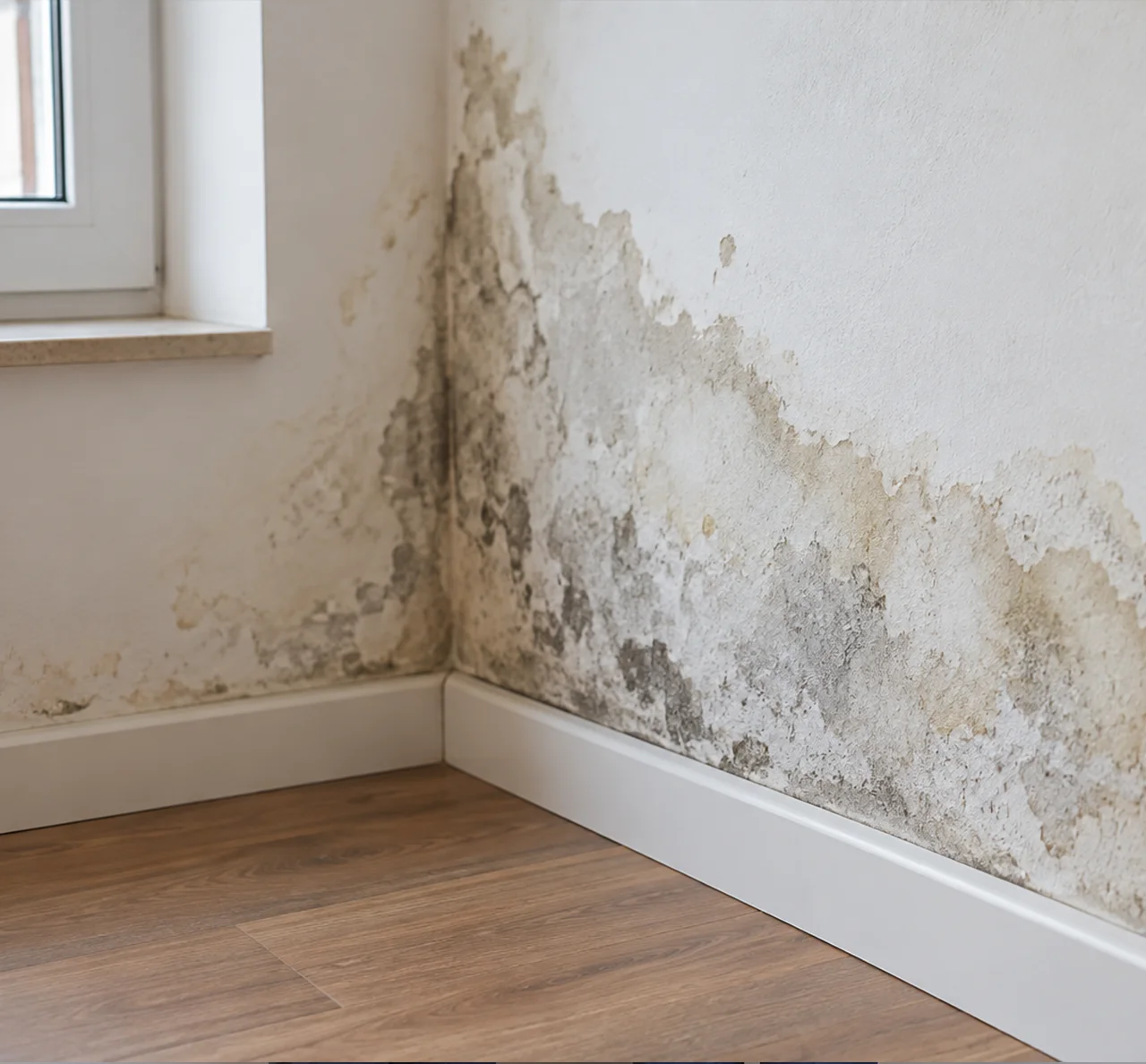
2. Rising damp: Rising damp is a different problem altogether. It occurs when moisture from the ground is absorbed by the building materials and moves upwards through the walls by capillary action — much like a paper towel absorbing water from one end. Rising damp can often be recognised by:
- A relatively horizontal band of damp at the bottom of the wall
- Damp usually extending to less than approximately one metre in height
- Crumbling or deteriorating plaster
- White crystalline deposits known as efflorescence
- A persistent smell of damp or mould
- More intense signs close to the floor
This type of damp can be more difficult and more expensive to resolve, because it may require intervention involving the building's waterproofing or damp-proofing system.
Simply repainting the wall, improving ventilation or covering the affected area with plasterboard or tiles may only conceal the problem temporarily. Over time, the underlying moisture can cause the new finishes to deteriorate again.
3. Water infiltration: Water infiltration is the type of damp that generally requires the most immediate attention. It usually indicates a specific physical problem, such as:
- A damaged or leaking roof
- Poorly sealed windows or frames
- Cracks in an external wall or façade
- Leaking pipes inside a wall
- Defects in waterproofing
Water infiltration can often be identified by stains that appear or become significantly worse after heavy rainfall. The stains may have an irregular shape and often spread from a specific point, such as a window, the junction between a wall and ceiling, or along the route of a pipe. Unlike condensation, water infiltration tends to get worse over time if the underlying cause is not repaired, because water continues to enter the building whenever it rains.
When should damp be a genuine warning sign?
Not every damp stain means that a property is seriously problematic. This is important, particularly when buying a house or apartment. For example, isolated signs of condensation with a clearly identifiable cause do not necessarily mean that the property has a major defect. What should raise more concern is the combination of several warning signs, such as:
- Damp appearing in several apparently unrelated areas
- Stains returning shortly after being painted
- A persistent mould smell, even with adequate ventilation
- Plaster that is loose, crumbling or falling away • Damp that becomes significantly worse after rainfall
- Signs of deterioration around windows, ceilings or external walls
These signs can indicate a problem that is older or more extensive than what is visible on the surface.
This is particularly relevant when a property has recently been repainted before being put on the market. Fresh paint can temporarily conceal damp stains, but it does not necessarily solve the underlying cause.
What does this mean if you are buying a property?
This is one of the key differences between a normal property viewing and a technical property inspection.
Damp is rarely completely visible during a standard viewing. A buyer sees a painted wall and a ceiling that appears dry on the day of the visit.
What they cannot normally see is what is happening behind the plaster. Without appropriate diagnostic equipment, it can also be difficult to determine whether a recent stain is simply the result of condensation or an early sign of a more serious water infiltration problem.
That is why a property inspection before buying a house is not an unnecessary precaution. It is a way of turning a decision based on appearances into an informed property investment decision.
For most people, buying a property is one of the largest financial commitments they will ever make.
Knowing the likely source of a damp stain, understanding its potential severity and assessing the likely cost of resolving the problem before signing a purchase agreement can make the difference between negotiating with the right information and discovering an expensive problem after the transaction has been completed.
What should you do if you find signs of damp?
If you are living in a property with damp, the first step should always be to identify the type and cause of the damp before attempting to repair it.
For example, painting over an active water infiltration problem may only result in wasted money or temporarily hide the visible damage. If the source of the water remains, the problem will continue.
If you are buying or selling a property and have noticed — or suspect — signs of damp, the sensible next step is to arrange a professional property inspection.
A technical inspection can help distinguish between condensation, rising damp and water infiltration, identify the likely source of the problem and determine whether further investigation or corrective work may be required. Damp will not simply disappear on its own.
But it is also important to remember that not every damp stain is evidence of a serious propert
y defect — or necessarily a reason to walk away from a property. The difference lies in understanding what is actually happening, where the problem comes from and how serious it really is.
That is why BLEPO exists.
See better. Decide better.
See better. Decide better.
Subscribe our newsletter

Blepo
Useful Links
Headquarters
A.: Lagoas Park Edifício 7,
2740-244 Porto Salvo - Oeiras
Lisboa, Portugal | Get directions
T.: +351 211 224 781*
E.: geral@blepo.pt
* Cost of a call to a national landline.
Operating hours: 9 AM to 6 PM on weekdays.
 Talk with us
